Porsche Mission E: the concept that became the Taycan
The Mission E was the first Porsche Mission concept and the first to become a production car, the Taycan. Four years separated the show stand from the production line. This page compares what Porsche promised in 2015 with what it delivered in 2019.
By Mario Bailey. Published , updated .

The short answer
- The Mission E was an all-electric four-door, four-seat concept Porsche showed at the IAA in Frankfurt in September 2015.
- Porsche approved it for production on 4 December 2015, named the production car Taycan in June 2018, and held the Taycan world premiere on 4 September 2019.
- The launch Taycan Turbo S kept or beat three of the concept's main figures: 800-volt architecture, more than 600 hp, and 0 to 100 km/h in under 3.5 seconds.
- The launch Taycan, as Porsche described it, used touch screens and voice control where the concept had eye tracking, a holographic display and gesture control, and its fast charging took longer than the concept claimed.
Checked against Porsche's own releases on .
What Porsche showed in 2015
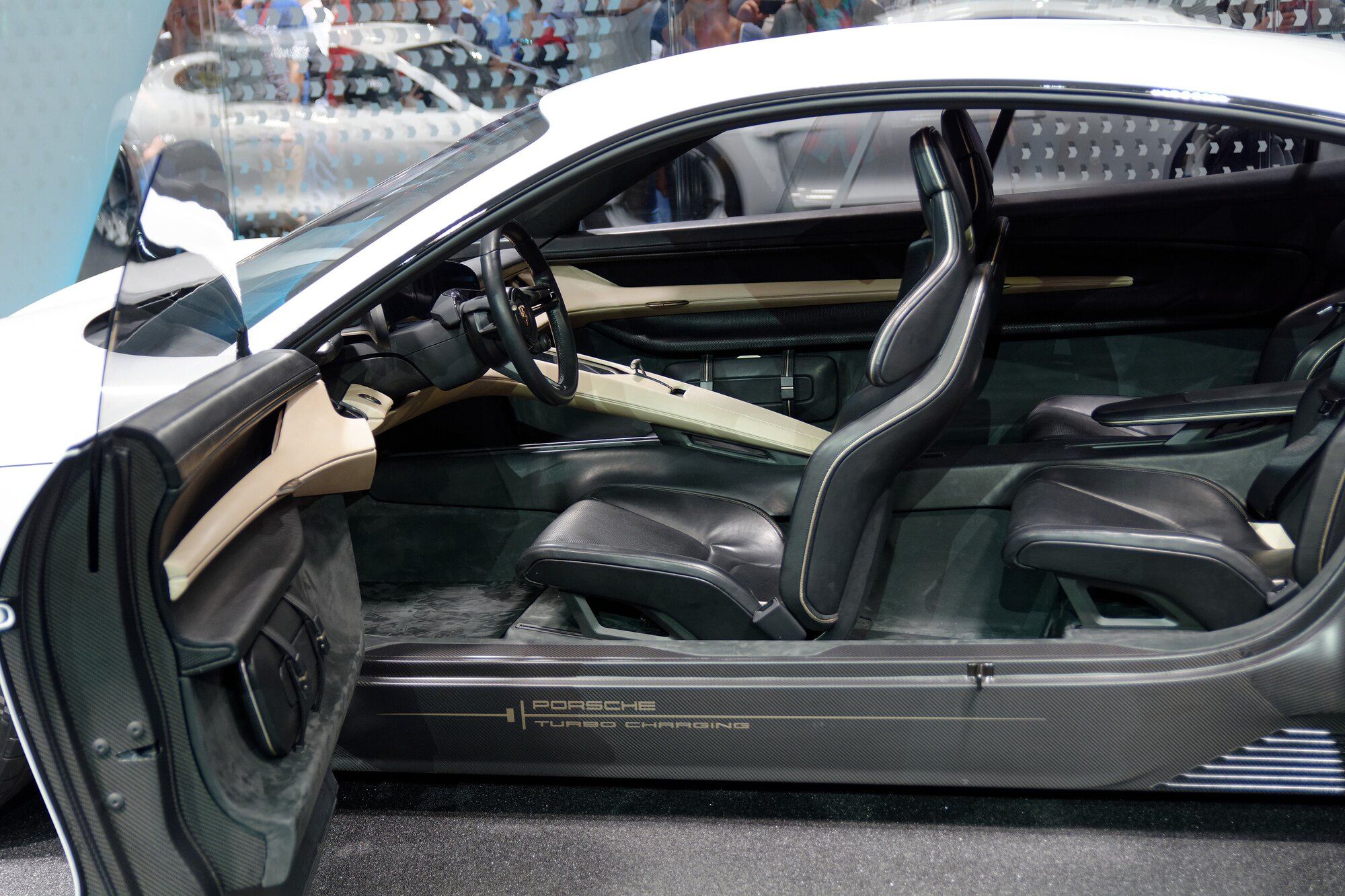
Porsche presented the Mission E in Frankfurt as "the first all-electrically powered four-seat sports car in the brand's history". Its launch release listed four doors and four single seats, more than 600 hp (440 kW) from two permanent magnet synchronous motors, all-wheel drive and all-wheel steering, more than 500 km of range and a Nordschleife lap "under the eight-minute mark".
The central technical claim was the voltage. Porsche said the Mission E introduced an 800-volt system, double the 400 volts of the electric cars of the day, which it said allowed shorter charging times and lighter copper cables. Its "Porsche Turbo Charging" port would take the battery to about 80 percent in around 15 minutes.
The concept also had features of a show car. It had two counter-opening doors with no B-pillar between them, and cameras in place of door mirrors. Its five round instruments were displayed in OLED and selected by an eye-tracking camera. A holographic display reached across to the passenger side, with apps selected by gesture. A camera in the rear-view mirror was meant to recognize the driver's good mood and show it as an emoticon.

From show stand to factory: four years
14 September 2015
Mission E shown at the IAA in Frankfurt as "the first all-electrically powered four-seat sports car in the brand's history".
4 December 2015
Porsche's supervisory board gives the project the green light, with launch planned for "the end of the decade" and around 700 million euros for the Zuffenhausen site.
8 June 2018
The production name is announced at the "70 years of sports cars" celebration: Taycan, roughly "lively young horse".
26 August 2019
A pre-series Taycan laps the Nürburgring Nordschleife in 7 minutes 42 seconds.
4 September 2019
World premiere, held at the same time in North America, China and Europe. Taycan Turbo S and Turbo open for order.
9 September 2019
Scheduled start of production of the first customer cars in Zuffenhausen.
Porsche's supervisory board approved the project less than three months after the show. Porsche said it would invest around 700 million euros in Zuffenhausen, with a new paint shop, a new assembly plant and an engine factory expanded to make electric motors. Porsche later said the positive response to the Frankfurt show car "marked the start of the largest construction project" since the plant was founded. Porsche gave the construction period as less than 48 months. The 2015 promise was a launch "at the end of the decade", and customer production was scheduled to begin on 9 September 2019.
Promised vs delivered
Concept figures from Porsche's 2015 and 2018 releases. Taycan figures for the two launch models, from Porsche's August and September 2019 releases.
| Mission E (2015) | Taycan at launch (2019) | Outcome | |
|---|---|---|---|
| Output | Over 600 hp (440 kW) system power | Turbo S: up to 560 kW (761 PS) overboost with Launch Control. Turbo: up to 500 kW (680 PS) | Exceeded |
| 0 to 100 km/h | Under 3.5 seconds | Turbo S 2.8 seconds, Turbo 3.2 seconds | Met |
| System voltage | 800 volts; Porsche called it "the first 800-volt drive system" | 800 volts; Porsche calls it the first production vehicle with that system voltage | Kept |
| Fast charging | About 80 percent in around 15 minutes; enough for around 400 km in about 15 minutes | 5 to 80 percent in 22.5 minutes under ideal conditions; up to 100 km (WLTP) in just over five minutes; 270 kW peak | Slower than the concept claim |
| Range | Over 500 km (NEDC, per Porsche's 2018 release) | Up to 412 km (Turbo S) and 450 km (Turbo), WLTP. EPA rating for the 2020 model year: 192 miles (Turbo S) and 201 miles (Turbo) | Not directly comparable (different test cycles) |
| Nordschleife | Lap time "under the eight-minute mark" | 7:42 by a pre-series car, August 2019 | Met |
| Instruments and controls | Five virtual round OLED instruments, eye tracking, a holographic display and gesture control | Curved 16.8-inch instrument screen, touch screens and "Hey Porsche" voice control | Changed |
What survived, and what did not
Most of the engineering survived. The launch Taycan Turbo S met or beat the concept's output and 0 to 100 km/h claims. The 800-volt system reached production, and Porsche calls the Taycan the first production vehicle with that system voltage. A pre-series Taycan lapped the Nordschleife in 7:42, 18 seconds inside the concept's eight-minute target.
The shape survived. Porsche's own technical summary of the Taycan says that "overall, the Taycan has remained very close to Porsche's 2015 Mission E concept car." In 2021 Porsche went further, saying the Taycan "closely resemble[s]" the concept "in terms of appearance and technology", and summing it up as "mission accomplished".
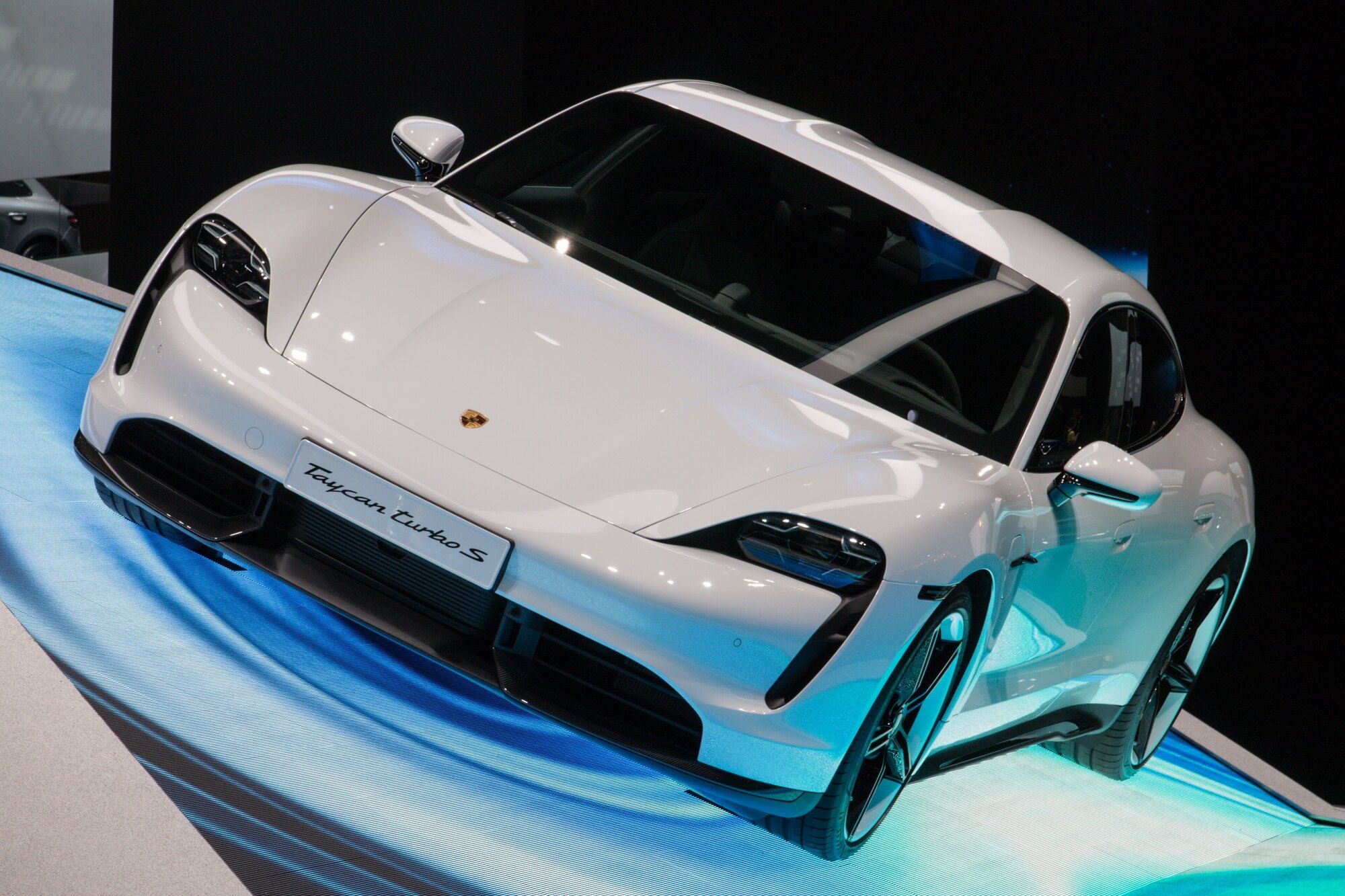
The show-car features did not. The Taycan Porsche described in August 2019 uses a curved 16.8-inch instrument screen, touch operation and voice control. One of its four display modes evokes round instruments. Porsche's interior release does not mention eye tracking, a holographic display or gesture control. The production car in the photo here has conventional door mirrors and a pillar between its front and rear side windows. We have found no Porsche statement explaining those changes, so we do not offer a reason.
Charging came in slower than the concept claimed. The concept's approximately 80 percent in around 15 minutes became 5 to 80 percent in 22.5 minutes under ideal conditions. Range cannot be compared directly: Porsche's 2018 release gave the concept's 500 km on the NEDC cycle, and the Taycan's launch figures are WLTP. In the United States, the EPA rated the 2020 Taycan Turbo at 201 miles and the 2020 Taycan Turbo S at 192 miles, asfueleconomy.gov lists them.

What the Mission E tells you about the Mission S
This section is our reading, not Porsche's.
- The Mission E's performance numbers proved conservative. The launch Taycan Turbo S beat the concept's output and acceleration figures. Porsche has given the Mission S no performance figures.
- The interior changed most. The Mission E's cabin was the part furthest from the production car. Porsche's release describes the Mission S interior with five round instruments, no permanently integrated center display and a retractable smartphone system. The Mission E also showed five round instruments in 2015.
- The name came late. "Taycan" arrived 33 months after the concept and about 15 months before the premiere. Porsche has announced no production name for the Mission S.
The Mission E previewed one model. Porsche describes the Mission S as a vision model for a design identity and aplatform, which is a different kind of commitment. The full record of Porsche concepts and what became of them is on Will the Mission S be built?, and the concept that followed this car is on the Mission E Cross Turismo page.
Keep reading
- Every Porsche Mission conceptMission E, E Cross Turismo, R, X and S, and what each one led to.
- Mission E Cross Turismo (2018)The raised electric concept that became the Taycan Cross Turismo.
- Mission R (2021)An electric customer racing car study.
- Mission X (2023)The electric hypercar concept: specs, status and release date questions.
- Porsche Mission S overviewWhat the car is, why Queens, and the quick answers.
- Porsche's mid-engine supercars550 Spyder, 904, GT1, Carrera GT, 918 Spyder, Mission S.
Sources
- World premiere for Porsche Mission E, Porsche Newsroom, 2015-09-14. Every Mission E concept figure and feature: output, 800 volts, charging, doors, cameras, instruments, Nordschleife target.
- Green light for Porsche Mission E, Porsche Newsroom, 2015-12-04. Production approval, launch target, Zuffenhausen investment.
- Mission E becomes Taycan, Porsche Newsroom, 2018-06-08. Taycan name, its meaning, and the concept's NEDC range.
- New Porsche Taycan sets a record at the Nürburgring-Nordschleife, Porsche Newsroom, 2019-08-26. Pre-series Taycan Nordschleife time.
- Digital, clear, sustainable: the interior of the new Porsche Taycan, Porsche Newsroom, 2019-08-23. Taycan instrument screen, display modes and controls.
- World premiere of the Porsche Taycan: Sports car, sustainably redesigned, Porsche Newsroom, 2019-09-04. Taycan world premiere, launch output, acceleration, range and charging.
- Compare Side-by-Side: 2020 Porsche Taycan Turbo and 2020 Porsche Taycan Turbo S, fueleconomy.gov (US Department of Energy and EPA), undated. EPA range ratings for the 2020 Taycan Turbo (201 miles) and Taycan Turbo S (192 miles).
- Punctual start of production for the Porsche Taycan, Porsche Newsroom, 2019-09-06. Start of production date, factory build time, the show car as the start of the project.
- Technical Feature: The Porsche Taycan, Porsche Newsroom Australia, 2021-02-25. Porsche's statement that the Taycan stayed close to the Mission E.
- Porsche presents its future-driven Mission R concept study, Porsche Newsroom Australia, 2021-09-06. Porsche's 2021 summary that the Taycan resembles the Mission E.
- Porsche Mission S: the essence of the sports car reinterpreted, Porsche Newsroom, 2026-10-15. Mission S described as a vision model and platform; its five round instruments, no fixed center display and retractable smartphone system.
Spotted an error? Tell us and it goes on the corrections log.