Why mid-engine? The Mission S layout explained
The clearest technical fact Porsche has given about the Mission S is where its engine sits. That layout separates it from the 911 below it in the range. This page explains each layout and quotes what Porsche claims for each.
By Mario Bailey. Published , updated .

The short answer
- The Mission S is mid-engined: Porsche says its engine "is positioned centrally in the vehicle". The engine type is not announced.
- In a mid-engined car the engine sits behind the seats and in front of the rear axle; in the 911 it sits in the tail, over the rear wheels.
- Porsche credits the 911's rear engine with better traction and braking, and its mid-engined cars with more balanced weight distribution.
- Porsche moved the engine of its first car, the 356 No. 1, from the middle to the rear for the coupe, to make room for emergency seats and luggage.
Checked against Porsche's own releases on .
Three layouts in plain terms
"Mid-engine" describes where the engine sits relative to the seats and the axles. Porsche has built all three common arrangements.
| Layout | Where the engine sits | Porsche examples |
|---|---|---|
| Front engine | Ahead of the cabin | 924, 928, 944 and 968, which Porsche describes as transaxle sports cars |
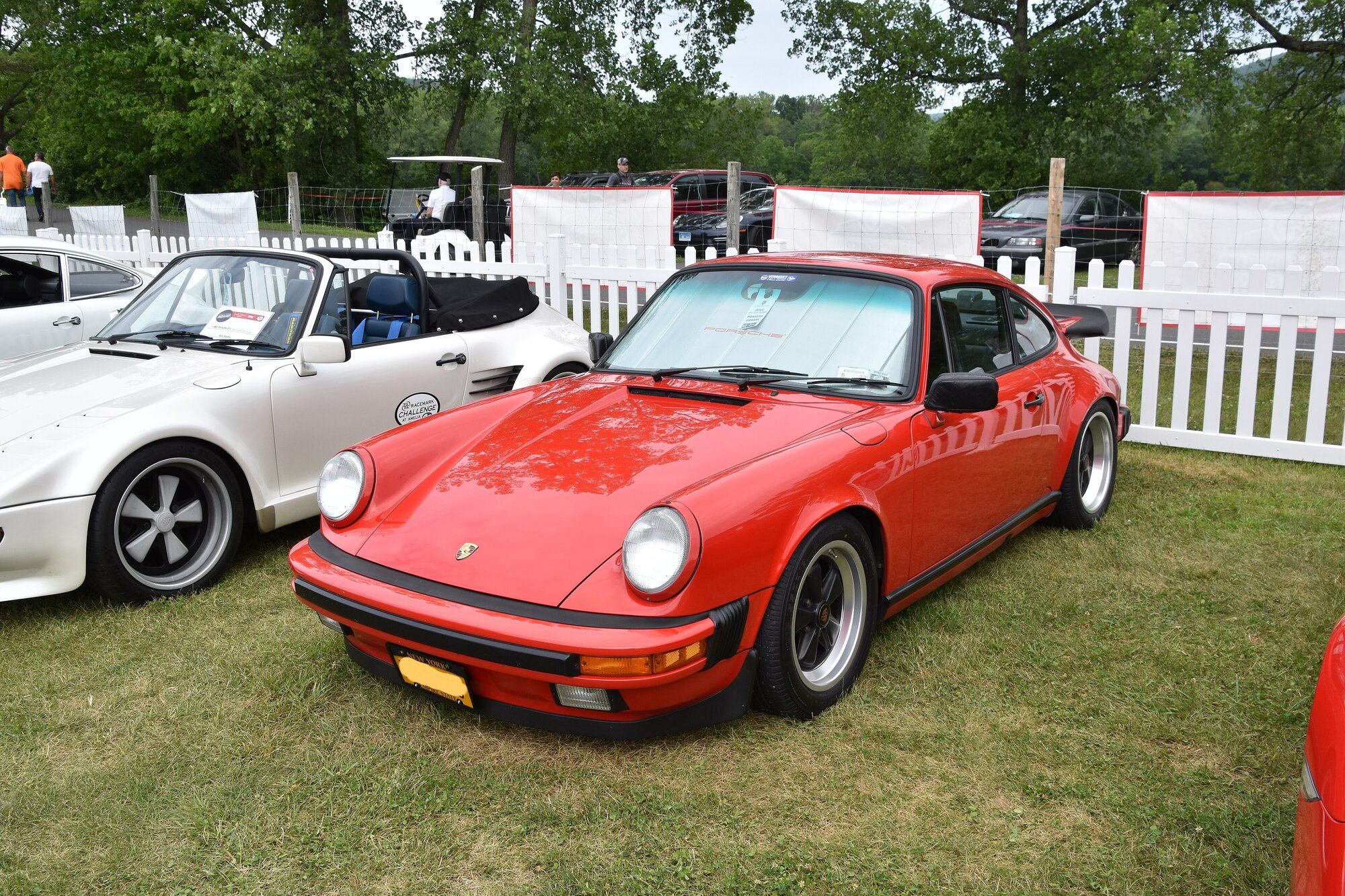
| Rear engine | In the tail, over the driven rear wheels | Every 911 since 1963 |
| Mid engine | Behind the seats, in front of the rear axle | 550 Spyder, 904, 914, Boxster and Cayman, Carrera GT, 911 GT1, and now the Mission S |
Porsche's 2019 history of the layout describes the mid-engine as "the engine in front of the rear axle". Its 2025 explainer on the 911 describes the rear engine as weight that "rests on the driven axle", with the engine "placed over its rear wheels". In both a mid-engined car and a 911 the engine is behind the driver. The difference is whether it sits ahead of the rear wheels or over them.
What Porsche says the rear engine gives the 911
Porsche's explanation: "When the engine is fitted in the rear, traction is improved because the weight of the engine rests on the driven axle, especially in winter or low-traction conditions. Braking performance is also improved, as the weight of a rear-mounted engine allows more braking force to be transferred to the rear wheels."
Porsche also ties the layout to the way a 911 looks. Michael Mauer, Porsche's chief designer for more than 20 years, said in the same piece that the 911's design "starts at the front", with "a special topography where the wings are higher than the bonnet. And that's because the engine is in the rear." His conclusion: "If I had to fundamentally change the layout, it wouldn't be a 911 anymore."

What Porsche says the mid-engine gives its other cars
For the mid-engine, the most direct statement comes from Jan Roth, then director of the 718 model range, in Porsche's 2019 history: "the more balanced weight distribution and having the weight centered in the middle of the vehicle creates sophisticated driving dynamics that can be experienced." The same article adds two more points. Andreas Preuninger, director of GT cars, says the driver and passenger sit "closer to the machine". And the mid-engine leaves room at the back for a diffuser channel, which Porsche says raised the 718 Cayman GT4's downforce by 25 percent without adding drag.
Preuninger had said much the same in 2015, when Porsche's magazine Christophorus covered the first Cayman GT4: "We in the GT team have always had our eyes on the Cayman, because its mid-engine configuration is very exciting. It's extremely maneuverable, a genius in driving pleasure."
Porsche's history also records the cost. The engine takes space that rear seats and luggage could use, which is the reason the company's first car changed layout. The 356 "No. 1" Roadster of 1948 had its four-cylinder in front of the rear axle. "But the two-seater convertible didn't offer Ferry Porsche enough storage space. For the coupe model, the engine therefore shifted to the back, making space for emergency seats and luggage." Porsche calls that switch "the birth of the classic Porsche."
These are Porsche's claims about its own cars, and we have not tested them. The 356 page covers that car's history.
Why Porsche kept two layouts
Porsche has used the two layouts to separate its cars. Its 2019 history says that until 1969 every series-production Porsche had its engine in the back. The 914 changed that, keeping its boxer engine "in front of the rear axle", and after 914 production ended the mid-engine concept "was put on ice for two decades". It came back with the Boxster. The 1993 Boxster concept car referred on purpose to the 550 Spyder and 718 RS 60, and Porsche names "the mid-engine concept" among the features it shared with them. Of the production car that followed in 1996, Roth says, "the decision in favor of the mid-engine in the 1990s was also influenced by the desire to distinguish the Boxster from the 911." The 911 kept its rear engine through the change from air to water cooling in 1997, and Porsche's 2025 explainer calls that layout "the starting point for all further developments of the 911."
Several of its racing cars and top road cars went the other way. "The mid-engine idea ignited the Porsche legend," Porsche's 2019 history says, pointing to the 550 Spyder, and it calls the 904 a mid-engine car too. The early 911 GT1 road cars, despite the name, had the race car's engine "mounted in a mid-engine position", in Porsche's words. When Porsche marked 25 years of the Carrera GT in 2025, it listed the "mid-engine principle" among the things that car embodied. The full line, with output and build numbers, is on our mid-engine supercars page. The 959 is the exception. Its engine sits at the rear, as our 959 page explains.
What the Mission S tells us about its layout
Porsche's release says: "The proportions of the show car are characterised by its mid-engined architecture. The engine is positioned centrally in the vehicle, which enables the familiar 'flyline' to be realised." Flyline is what Porsche's designers call a roofline "sloping downward to the rear". On the Mission S the release describes a roofline beneath the rear wing that is "reminiscent of the 959". Our design page covers that line and the other historic references.
Design chief Tobias Sühlmann, Vice President Style Porsche, told Auto Express that the engine position set the size of the car: "Where does the engine sit, and what could the package be? This is what we defined to come up with the size of that car." He added: "Relatively compact is important and clearly it's a mid-engined concept." And on the open rear: "Look through the diffuser and you see the gearbox or the rear tyres."
Our reading: the layout also lets the Mission S borrow the 911's face. Mauer tied the 911's raised fenders to its rear engine. With no engine in the nose, the hood can sit below the fenders. A mid-mounted engine leaves the nose just as free, and the release gives the Mission S fenders that "echo the familiar 'torpedo' design" and are "reminiscent of the 911".
Auto Express reports that a modular mid-engined platform, MMB, will underpin both the production Mission S and the future 911, and explains that Porsche's engineers use "platform" to mean a toolbox of shared components. That is not a statement that the 911 will move its engine, and Porsche's releases say nothing of the kind. Porsche has not said what the engine will be. See the engine page and the spec sheet.
Quick answers
Is the Porsche Mission S mid-engined?
Yes. Porsche's release says the show car's proportions "are characterised by its mid-engined architecture" and that "the engine is positioned centrally in the vehicle". Porsche has not said what the engine is.
What is the difference between mid-engine and rear-engine?
Both put the engine behind the people. In a mid-engined car it sits in front of the rear axle, close to the middle of the car; in a rear-engined car such as the 911 it sits in the tail, over the rear wheels.
Will the 911 become mid-engined?
Nothing Porsche has said points that way. Its 2025 explainer calls the rear engine the starting point of every 911, and Michael Mauer, Porsche's chief designer for more than 20 years, said that if he changed the layout "it wouldn't be a 911 anymore." The Mission S is planned to sit above the 911, not to replace it.
Back to the Mission S overview, or see where the car sits in the range on above the 911.
Keep reading
- Porsche Mission S overviewWhat the car is, why Queens, and the quick answers.
- Specs: confirmed vs reportedEvery stated fact, and every rumor with its source.
- The engineFlat-eight, hybrid or both: what Porsche said and where the reports came from.
- Price and release dateThe $600,000 and €500,000 reports, timing, and whether you can order.
- The eight design references911, G-model, GT1, 959, 917 and 928 outside; 550 Spyder and 356 inside.
- The interiorFive round dials, no center screen, a phone holder.
- Will it have a manual?What Porsche said about a manual gearbox, and its record of offering one.
- Will the Mission S be built?What became of every Porsche concept that previewed a production car.
- Above the 911Where a permanent model line would sit in Porsche's range.
- Mission S rivalsThe mid-engined Ferrari, Lamborghini and McLaren cars it would face.
- Porsche's 2035 strategySportwagenschmiede '35, the plan the Mission S was revealed to launch.
- Michael Leiters, Porsche CEOThe engineer from Ferrari and McLaren who presented the car.
- Mission S vs Mission XThe 2023 electric hypercar study against the 2026 car.
- Mission S timelineTeasers, the leak, the premiere and what came after.
- Every Porsche Mission conceptMission E, E Cross Turismo, R, X and S, and what each one led to.
- Porsche's mid-engine supercars550 Spyder, 904, GT1, Carrera GT, 918 Spyder, Mission S.
Sources
- Porsche Mission S: the essence of the sports car reinterpreted, Porsche Newsroom, 2026-10-15. Mid-engined architecture, engine positioned centrally, flyline, torpedo fenders.
- Porsche Mission S supercar reveals brand's future look and plan to challenge Ferrari, Auto Express (Phil McNamara), first published 2026-10-07 and updated, 2026-10-16. Sühlmann on the engine position and package; the MMB platform report.
- Why is the Porsche 911 engine in the rear?, Porsche, 2025-12-02. Rear engine: traction, braking, Mauer quotes, the 911 since 1963 and the 996 in 1997.
- Right in the Middle, Porsche Newsroom, 2019-09-18. Mid-engine definition, Roth and Preuninger quotes, GT4 diffuser, 356 No. 1, 550 Spyder, 904, the 914 and the two-decade pause, Boxster, transaxle cars.
- The Boxster sports car concept: trendsetting design and clever detailed solutions, Porsche Newsroom, 2021-01-14. The 1993 Boxster concept, its references to the 550 Spyder and 718 RS 60, and its mid-engine concept.
- The rebel, Porsche Newsroom (Christophorus), 2015-03-03. Preuninger in 2015 on the Cayman's mid-engine configuration.
- What is the Porsche 911 GT1 Strassenversion?, Porsche, 2025-09-05. The early GT1 road cars' mid-mounted engine.
- The exterior design: Pure new design with Porsche DNA (Taycan press kit), Porsche Newsroom, 2019-09-04. Porsche's definition of the flyline.
- Porsche Carrera GT: A legendary supercar marks its milestone, Porsche Newsroom, 2025-09-28. Carrera GT and the "mid-engine principle".
Spotted an error? Tell us and it goes on the corrections log.