Porsche 356: the first Porsche had its engine in the middle
The production 356 was rear-engined. The first 356, the No. 1 Roadster of 1948, carried its engine in front of the rear axle. Porsche now credits the 356 for the cabin of its mid-engined Mission S vision model.
By Mario Bailey. Published , updated .

The short answer
- The first car to carry the Porsche name, the 356 “No. 1” Roadster, received its general operating permit on 8 June 1948. Porsche treats that date as the birth of the brand.
- The No. 1 was mid-engined: its modified Volkswagen flat-four sat in front of the rear axle. The production 356 moved the engine to the rear.
- Porsche built the 356 until 1965. Its own pages give about 78,000 cars, or 77,361.
- Porsche says the Mission S interior architecture is based on the 356 and the 550 Spyder: two lines through the dashboard and doors give the feeling of sitting “deep within the car”.
Checked against Porsche's own releases on .
Built in a former sawmill in Austria
In 1944, with bombing raids on Stuttgart becoming more frequent, Ferdinand Porsche moved his design office to Gmünd in Carinthia, Austria. Around three hundred employees worked in the buildings of a former sawmill, short of machines and materials.
Ferdinand Porsche was interned by the French from December 1945 until 1947, so the company fell to his son Ferry. It survived on tractors, cable winches and other agricultural machinery, and on a vehicle contract, the Type 360 Cisitalia, for the Italian race car maker of that name. Porsche says that contract provided the money for the sports car Ferry wanted. Porsche quotes him: “In the beginning I looked around and could not find quite the car I dreamed of. So I decided to build it myself.”
No. 1: a mid-engined roadster
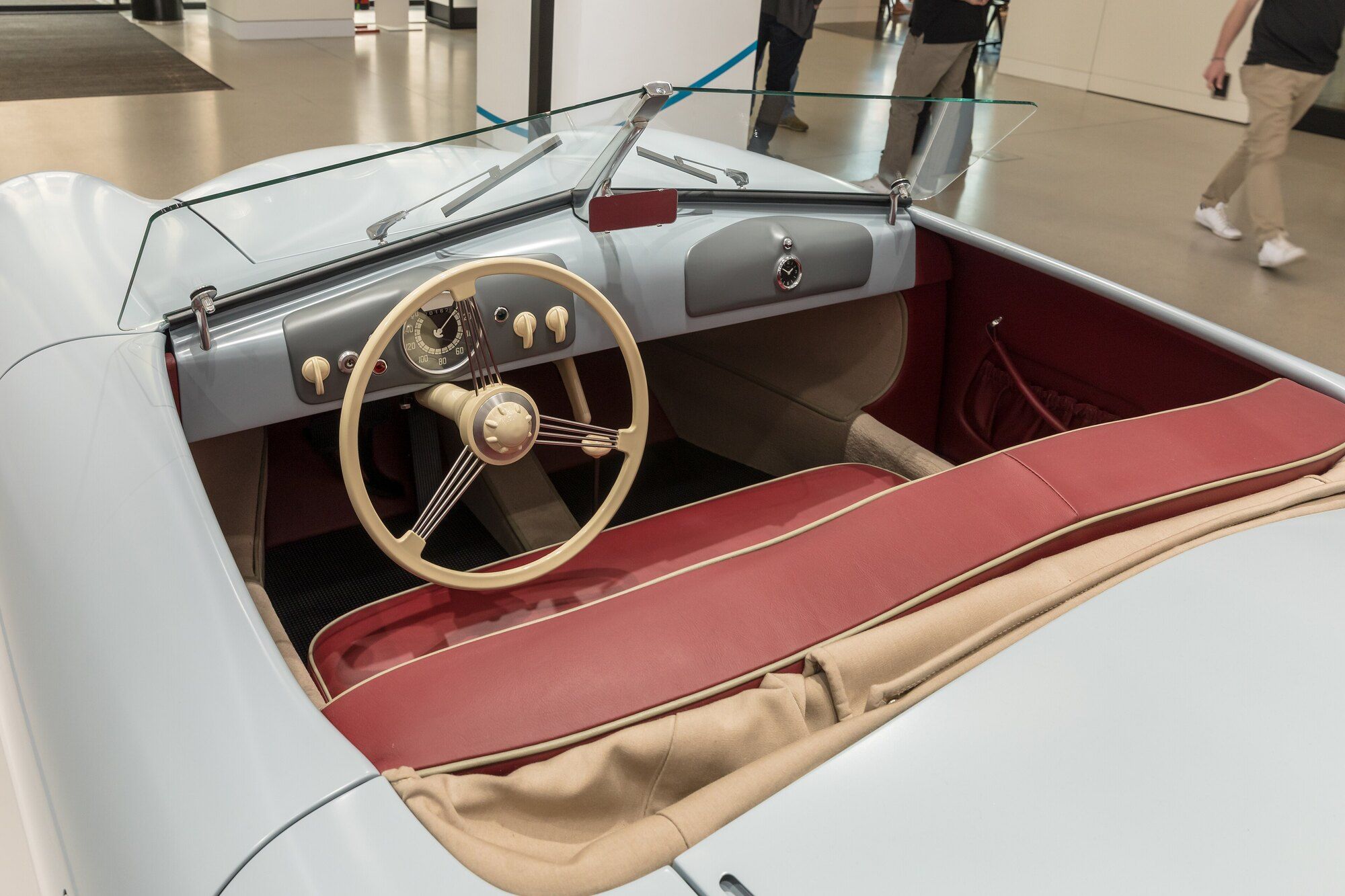
The first car was at first called the VW Sport. Porsche built a tubular steel frame and an aluminum body, and took the front axle, gearbox and engine from the Volkswagen Beetle, whose flat engine Porsche's design office had developed in the 1930s. New cylinder heads and tuning raised the 1,131 cc flat-four to 35 PS. The car weighed 585 kg and reached 135 km/h. Chassis number 356.001 received its general operating permit on 8 June 1948, and Porsche says it ran a demonstration lap at a city street race in Innsbruck.
Porsche's museum entry states the layout: the engine "was located in front of the rear axle", and the No. 1 "remained a truly one-off unit, as the series-production version was fitted with a rear-mounted engine". Porsche's own articles call the No. 1 a mid-engine two-seater.
The car was sold soon after it was finished and changed a good deal in private hands. When Porsche bought it back, it chose to keep it as found. For the 70th anniversary in 2018 the museum built a second car that recreates its 1948 form, with a different nose, a narrower rear and a one-piece rear lid.
Why the production 356 moved the engine
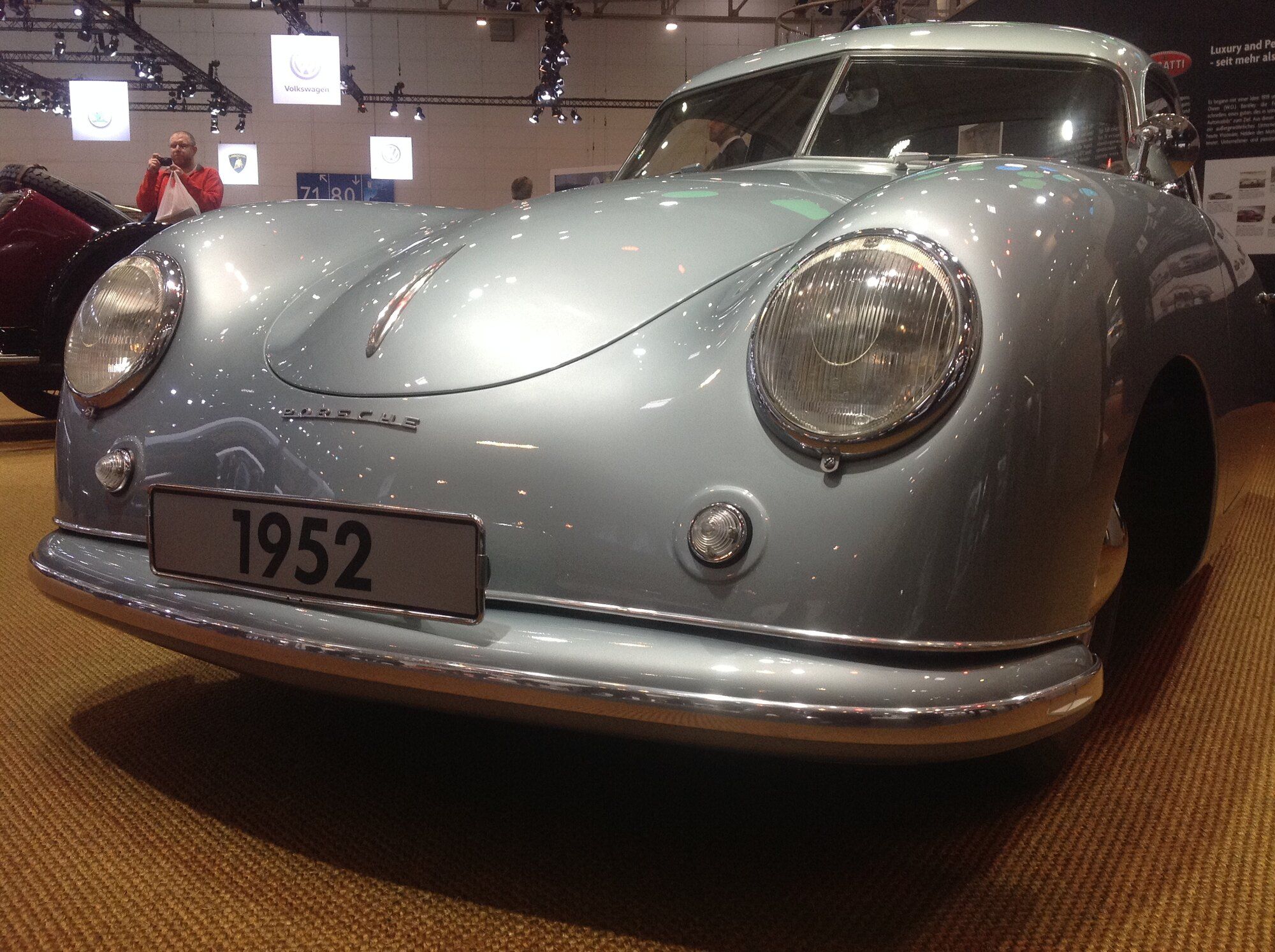
Work on the 356/2 ran alongside the No. 1, and the first coupé was finished in August 1948. It had a steel box frame instead of the tubular one, 40 PS, and the engine moved to the rear. Porsche gives the reason: the move created space for jump seats and luggage. The 911 still carries its engine behind the rear axle.
Gmünd built 52 of these cars, 44 coupés and eight cabriolets, before production in Austria ended in 1950. Their aluminum panels were shaped by hand with hammers and checked again and again against a wooden frame of ash. Porsche says the frame itself was never hammered, and that forming the outer skin took a specialist at least 90 hours. Porsche used outside specialists for the bodywork, including Kastenhofer, Keibl and Tatra in Vienna and Beutler in Thun, Switzerland. The Gmünd cars were what Porsche showed at the Geneva Motor Show in spring 1949.
From Zuffenhausen to 1965
Porsche returned to Stuttgart in November 1949. The first 356 built in Germany was completed in Zuffenhausen on 6 April 1950, with a steel body from the coachbuilder Reutter. In the same year, Porsche's US company says, the New York importer Max Hoffman placed the first North American order for Porsches. In 1951 a 356 SL won its class on Porsche's first appearance at Le Mans.
The car went through four main versions: the original 356 (1948 to 1955), the 356 A (1955 to 1959), the 356 B (1959 to 1963) and the 356 C (1963 to 1965). Porsche built the 356 C and SC until April 1965. Ferry Porsche had expected to sell around 500 cars. Porsche puts the final total at just under 78,000.

What the Mission S takes from the 356
Porsche's Mission S release names the 356 once, and only for the cabin: "The interior architecture is based on historic Porsche sports cars such as the 550 Spyder and the 356. Two defining lines run through the dashboard and doors. They convey the characteristic feeling of sitting 'deep within the car' and create a visual link to the exterior design." Theinterior page covers the rest of the Mission S cabin.
Porsche does not say which 356, or which part of it, it means. As written, the reference is to a seating feel and two lines through the dashboard and doors, not to a specific dashboard or switch. The same release says the cabin has no permanently integrated center display and that all controls are aligned toward the driver.
There is a second thread that Porsche documents elsewhere but does not connect to the Mission S. The early 356 had three round instruments. From the 356 A of 1955, the rev counter moved to the center, a layout Porsche traces back to the 550 Spyder race car. The Mission S puts its rev counter, with an analog needle, in the middle of five round instruments. The connection is ours. Porsche does not make it in the Mission S release.
The Mission S is mid-engined, like the No. 1 Roadster and unlike the production 356. Porsche's release does not mention the No. 1, so the shared layout is not a stated reference. Themid-engine versus rear-engine page explains what the difference changes.

Quick answers
Was the first Porsche mid-engined?
Yes. The 356 “No. 1” Roadster, which received its operating permit on 8 June 1948, had its Volkswagen-based flat-four in front of the rear axle. Porsche’s own museum entry says the No. 1 stayed a one-off because the production 356 used a rear-mounted engine.
How many Porsche 356s were built?
Porsche gives about 78,000 in most of its history articles, and 77,361 in its US company timeline, built from 1948 to 1965.
Is the Mission S based on the 356?
Only its interior. Porsche says the Mission S interior architecture is based on historic sports cars “such as the 550 Spyder and the 356”, with two lines through the dashboard and doors. Porsche does not link the Mission S body or engine layout to the 356.
Notes on the numbers
- Total built: Porsche's history articles say about 78,000 or "just under 78,000" by 1965. The timeline published by Porsche's US company gives 77,361 after 17 years.
- The Gmünd cars: Porsche's Zuffenhausen anniversary article says the 52 hand-built cars were made between 1948 and 1950; the US timeline says "through 1949". Porsche's Gmünd article says production in Austria ended in 1950.
- No. 1 output: the museum entry gives 26 kW (35 HP); the Gmünd article gives 35 PS. They describe the same engine.
For where the 356 sits among Porsche's later flagships, see the mid-engined line, the550 Spyder that shares the interior credit, and the Mission S overview.
Keep reading
- Porsche's mid-engine supercars550 Spyder, 904, GT1, Carrera GT, 918 Spyder, Mission S.
- Porsche 550 SpyderThe first Porsche super sports car, and the 1953 Queens pier photo.
- Porsche 904 Carrera GTSA mid-engined road and race car with a plastic body.
- Porsche 917The Le Mans winner and its cooling-air fan.
- Porsche 911 G-modelThe impact-bumper 911 and the shut lines the Mission S quotes.
- Porsche 928The front-engined V8 Porsche and its phone-dial wheels.
- Porsche 959The 1980s technology flagship and its roofline.
- Porsche 911 GT1The Le Mans car with a road version and a mid-mounted flat-six.
- Porsche Carrera GTThe V10 with a manual gearbox, 1,270 built.
- Porsche 918 SpyderThe plug-in hybrid hypercar, 918 built.
- Porsche flat-eight enginesEvery Porsche that has used one, from the 804 to the 914/8.
- Porsche Mission S overviewWhat the car is, why Queens, and the quick answers.
- Every Porsche Mission conceptMission E, E Cross Turismo, R, X and S, and what each one led to.
Sources
- Porsche 356 "No. 1" Roadster (Porsche Museum press kit), Porsche Newsroom, undated. No. 1 engine in front of the rear axle, one-off status, production engine at the rear, steel body from 1950, specifications.
- Made in Austria, Porsche Newsroom, 2019-11-06. Gmünd, the sawmill, Ferry Porsche and his quote, Cisitalia, No. 1 data, the 356/2, 44 coupés and eight cabriolets, Geneva 1949, the 500-car estimate and the 78,000 total.
- Touring Party, Porsche Newsroom, 2019-01-12. No. 1 as a mid-engine two-seater, its later history and the 2018 recreation.
- The Original Frame, Porsche Newsroom, 2023-04-08. 52 cars, 44 coupés and eight cabriolets; panels hammered and checked against the ash frame; 90 hours per body; the outside specialists.
- Porsche and the four cylinder flat engine, Porsche Newsroom, 2016-04-27. Innsbruck demonstration lap; mid-engine replaced by a rear engine in production; Volkswagen flat engine developed by the Porsche design office in the 1930s.
- Porsche Vision 357: homage to the first Porsche model line, the 356, Porsche Newsroom USA, 2023-01-26. Model versions and years; about 78,000 by 1965.
- Porsche has been manufacturing in Zuffenhausen for 75 years, Porsche Newsroom, 2025-04-02. First Zuffenhausen 356 on 6 April 1950; Gmünd cars 1948 to 1950.
- Porsche Historical Background, Porsche Newsroom USA, undated. Max Hoffman order in 1950; 77,361 total.
- 75 years of Porsche sports cars: People, Models, Milestones, Porsche Newsroom, 2023-03-02. Return to Stuttgart in November 1949; 356 SL class win at Le Mans in 1951.
- Blue wonder, Porsche Newsroom Canada, 2020-05-21. 356 C and SC built until April 1965.
- Racing DNA: The centrally positioned tachometer, Porsche Newsroom, 2026-02-09. Three round instruments; centered rev counter from the 356 A in 1955.
- Porsche Mission S: the essence of the sports car reinterpreted, Porsche Newsroom, 2026-10-15. The Mission S interior architecture and its 356 and 550 Spyder reference; no permanent center display; the five round instruments.
Spotted an error? Tell us and it goes on the corrections log.