Porsche 550 Spyder: the car Porsche chose to stand behind the Mission S
Porsche premiered the Mission S on a pier in Queens where, it says, the first pictures of the 550 Spyder went around the world in 1953. The 550 was a small open racer with a 1.5-liter engine. This page covers the car and what Porsche says the Mission S takes from it.
By Mario Bailey. Published , updated .

The short answer
- The 550 Spyder of 1953 was the first Porsche built specifically for racing, with its engine in the middle. Porsche's Mission S release calls it the brand's first super sports car.
- Its Type 547 engine, a 1.5-liter four-cam flat-four, made 110 PS at 6,200 rpm.
- At the 1954 Carrera Panamericana Hans Herrmann won his class and finished third overall. Porsche took the Carrera name from that race.
- Porsche sources give 89 or 90 cars built. A 2016 Porsche history counts 40 of the later 550 A separately.
- The Mission S premiered on a pier in Queens. Porsche says the first pictures of the 550 on that pier went around the world in 1953. Porsche also credits the 550 and the 356 for the Mission S interior architecture.
Checked against Porsche's own releases on .
Porsche's first car built to race
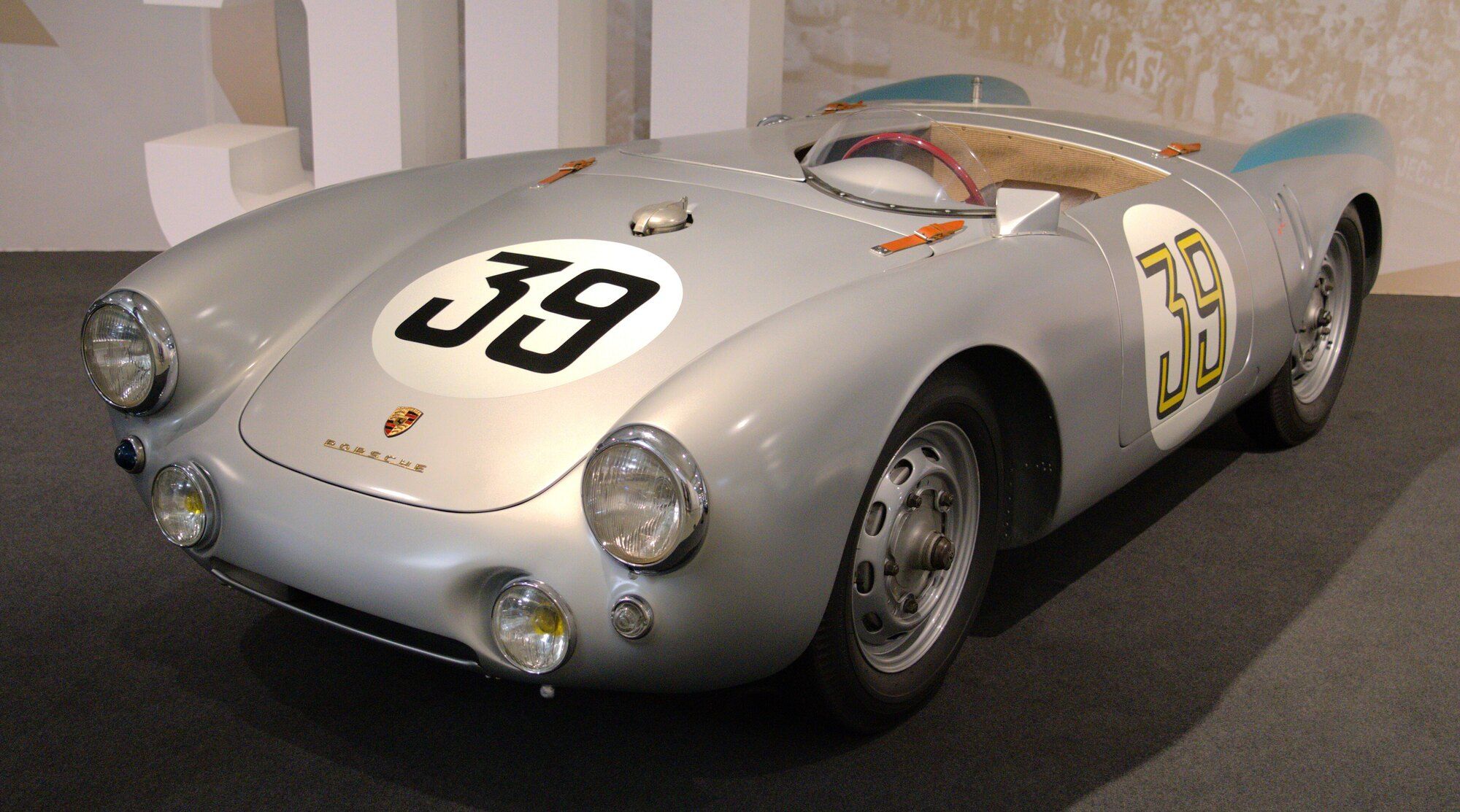
In 1952 Porsche decided to race as a manufacturer. The new car was to be compact, powerful, fast and above all light, so that a small engine could do the work. Porsche made it mid-engined, gave it an aluminum body and kept the unladen weight to 550 kg. Porsche used the internal type number, 550, as its name. "Spyder" comes from a coachbuilding term for a light, open carriage for two people, and Porsche still uses it for its open mid-engined sports cars.
Porsche says the 550 made its debut at the 1953 Paris Motor Show and won the first race it entered, the 1953 Eifel race at the Nürburgring. In June 1953 two 550s started at Le Mans for the first time and finished first and second in the 1.5-liter class. Porsche's history page gives the price as DEM 24,600.

The Type 547 four-cam engine
Ernst Fuhrmann, who joined Porsche in 1947 and later chaired its executive board, began reworking the four-cylinder boxer in summer 1952. His Type 547 drove its overhead camshafts through four vertical shafts, the part Porsche calls the "Königswelle", or king's shaft. Porsche says the shafts coped with higher engine speeds and kept valve timing precise at full throttle.
The first Type 547 ran on 2 April 1953. From 1.5 liters it made 110 PS at 6,200 rpm, against 70 PS for the production 356 1500. The museum's figures for the 550 are 1,498 cc, 81 kW (110 HP) and 220 km/h. Later versions went further: the 547/6 gave 135 PS at 7,200 rpm, and by the 1960s a two-liter version made 180 PS in the 904 Carrera GTS.
Racing record
Porsche sent Hans Herrmann and Karl Kling to the Carrera Panamericana in Mexico in November 1953 in two 550s. It was in this car, Porsche says, that it first moved the rev counter to the center of the round instruments, because engine speed mattered more to a racing driver than road speed. Porsche did not win there that year.
In 1954 Porsche entered four works 550s, driven by Salvador López Chávez, Fernando Segura, Jaroslav Juhan and Herrmann, over five days and more than 3,000 km. Herrmann beat Juhan by 36 seconds to win the class for sports cars up to 1,500 cc, and the two finished third and fourth overall against cars with far bigger engines. The Type 547 became known as the Carrera engine after the race, and Porsche later used the name on the 356 A Carrera and the 911.
The same year, at the Mille Miglia, Herrmann and his co-driver drove the low car under a closing railway barrier and came out unharmed. In 1956 Umberto Maglioli won the Targa Florio outright in a 550 A Spyder, Porsche's first win there, against Ferrari and Maserati. Porsche credits the 550 with five class wins at Le Mans between 1953 and 1958.
The 550 and America
The Mission S release says the 550 "laid an important foundation for Porsche's popularity and success in the US". Porsche's American company dates its first North American order, from New York importer Max Hoffman, to 1950, and lists the 550 in 1953 as a "giant killer" against bigger cars from Ferrari, Jaguar, Maserati and Aston Martin.
Porsche's own magazine, Christophorus, recounts that in September 1955 the actor James Dean traded his 356 Speedster for a silver 550 Spyder, and died in it on 30 September 1955 on his way to a race in Salinas, California.
The pier, and the photograph
Porsche's account is one sentence long: "The first pictures of the mid-engined Porsche 550 Spyder on this very pier made their way around the world in 1953." The release does not name the pier, the photographer or the occasion, and we have not reproduced the image here. Porsche gives its reason for the choice: "As the brand's first super sports car, the 550 Spyder is still regarded today as having defined the company's identity," and the location emphasizes "the importance of its history for the future of design and brand".
"First super sports car" is Porsche's own label. Its history of super sports cars starts with the 550 in 1953 and runs through the 904, 911 Turbo, 959, 911 GT1, Carrera GT and 918 Spyder. The mid-engined line page follows the mid-engined ones to the Mission S.
What the Mission S takes from the 550
Porsche's release ties the 550 to the Mission S in two places. The first is the venue. The second is the cabin: "The interior architecture is based on historic Porsche sports cars such as the 550 Spyder and the 356," with two lines through the dashboard and doors for the feeling of sitting "deep within the car". The interior page and the design references cover those in full.
The layout is implied rather than stated: the release opens by announcing a mid-engined super sports car platform, then describes the 550 as "mid-engined" when it explains the venue.
One more link is ours, not Porsche's. Porsche's own history traces the centered rev counter to the 550 in 1953. The Mission S puts a rev counter with an analog needle at the center of five round instruments, and moves it closer to the driver in some driving modes. The release does not credit the 550 for this.
Porsche has not named an engine for the Mission S. The engine page separates what Porsche said from what was reported.
Quick answers
How many Porsche 550 Spyders were built?
Porsche’s own sources differ: a 2016 Porsche Newsroom history gives 89 cars of the Type 550, and a 2023 porsche.com story gives 90 built between 1953 and 1956. The 2016 history counts the later 550 A Spyder separately, at 40 cars.
What engine did the 550 Spyder have?
The racing 550 used the Type 547, a 1.5-liter air-cooled flat-four with four overhead camshafts driven by vertical shafts, designed by Ernst Fuhrmann. Porsche gives 110 PS at 6,200 rpm and a top speed of about 220 km/h.
Why was the Mission S revealed on a pier in Queens?
Porsche says the first pictures of the 550 Spyder on that pier went around the world in 1953, and that the 550, its first super sports car, laid an important foundation for its success in the US. Porsche says the choice of location emphasizes the importance of its history for the future of its design and brand.
Notes on the numbers
- Built: 89 cars of the Type 550 from 1953 (Porsche Newsroom, 2016), or 90 race cars from 1953 to 1956 (porsche.com, 2023). The 2016 article counts 40 cars of the 550 A separately; the 2023 story does not say whether its 90 includes any.
- Year: Porsche's histories date the car to 1953; the Porsche Museum entry gives model year 1954 for its car.
- 1954 Panamericana distance: one Porsche page gives 3,077 km, another "over 3,000 kilometers".
- Weight: Porsche Newsroom gives an unladen weight of 550 kg; the 2023 porsche.com story says the car "weighed in at just 590kg".
- Engine at launch: Porsche dates the first Type 547 run to April 1953 and places it in Herrmann's 1954 Panamericana car. Porsche's pages do not say which engine every 1953 car used, so we do not either.
Back to the Mission S overview, or on to the 356, the other car Porsche credits for the cabin.
Keep reading
- Porsche's mid-engine supercars550 Spyder, 904, GT1, Carrera GT, 918 Spyder, Mission S.
- Porsche 356The first Porsche, and the interior idea the Mission S borrows.
- Porsche 904 Carrera GTSA mid-engined road and race car with a plastic body.
- Porsche 917The Le Mans winner and its cooling-air fan.
- Porsche 911 G-modelThe impact-bumper 911 and the shut lines the Mission S quotes.
- Porsche 928The front-engined V8 Porsche and its phone-dial wheels.
- Porsche 959The 1980s technology flagship and its roofline.
- Porsche 911 GT1The Le Mans car with a road version and a mid-mounted flat-six.
- Porsche Carrera GTThe V10 with a manual gearbox, 1,270 built.
- Porsche 918 SpyderThe plug-in hybrid hypercar, 918 built.
- Porsche flat-eight enginesEvery Porsche that has used one, from the 804 to the 914/8.
- Porsche Mission S overviewWhat the car is, why Queens, and the quick answers.
- Every Porsche Mission conceptMission E, E Cross Turismo, R, X and S, and what each one led to.
Sources
- Porsche Mission S: the essence of the sports car reinterpreted, Porsche Newsroom, 2026-10-15. The Queens pier, the 1953 photographs, "first super sports car", the US foundation, and the interior architecture.
- Porsche 550 Spyder (Porsche Museum press kit), Porsche Newsroom, undated. First Porsche built for racing; 1954 Panamericana; Mille Miglia barrier; model year 1954; specifications.
- A history of the iconic Porsche Spyder name, Porsche, 2023-09-15. Paris 1953 debut, first race win, 90 built, five Le Mans class wins, 1954 as the Mille Miglia year, 590 kg.
- Time travel: The Porsche 718, Porsche Newsroom, 2016-06-04. 89 cars of the Type 550; 40 of the 550 A and its space frame.
- “Königswelle”: Mechanical Masterpiece, Porsche Newsroom, 2025-01-16. Type 547 design, first run, output, later versions and the Carrera name.
- Porsche and the four cylinder flat engine, Porsche Newsroom, 2016-04-27. 1952 racing decision, mid-engine, aluminum body, 550 kg.
- 718 Spyder RS Panamericana Special: A tribute to a historic victory, Porsche Newsroom, 2024-10-14. The four 1954 works drivers, class up to 1,500 cc, distance, the Carrera engine and the name on later models.
- The Porsche 550 Spyder: reimagined by Hedley Studios, Porsche Newsroom, 2026-09-15. Herrmann and Juhan, 36-second margin, third and fourth overall.
- 75 years of Porsche sports cars: the greatest motorsport triumphs, Porsche Newsroom, 2023-06-05. Maglioli's 1956 Targa Florio win.
- 75 years of Porsche sports cars: People, Models, Milestones, Porsche Newsroom, 2023-03-02. First and second in class at Le Mans, June 1953.
- Racing DNA: The centrally positioned tachometer, Porsche Newsroom, 2026-02-09. The 1953 Panamericana entry and the centered rev counter.
- The super sportscars from Porsche, Porsche Newsroom, 2016-01-02. Porsche's super sports car list; DEM 24,600 price; 550 kg.
- The Porsche Code, Porsche Newsroom, 2015-12-21. Type number as model name; meaning of Spyder.
- Porsche Historical Background, Porsche Newsroom USA, undated. Max Hoffman's first order; "giant killer".
- Unforgotten, Porsche Newsroom (Christophorus), 2018-01-24. James Dean and his 550 Spyder.
Spotted an error? Tell us and it goes on the corrections log.