Porsche 911 G-model
The G-model is the 911 that Porsche planned to replace and instead built for almost 16 years. The Mission S refers to it for one detail: its shut lines.
By Mario Bailey. Published , updated .

The short answer
- The G-model is the second 911 generation, in production from August 1973 to July 1989.
- Its bellows bumpers answered US rules that Porsche describes as requiring a 5 mph (8 km/h) impact without damage.
- It spanned the 2.7-liter cars, the Carrera 3.0, the 911 SC, the Carrera 3.2 and the first 911 Turbo (930).
- Porsche gives 198,496 built in two histories and 196,397 in a third.
- Porsche says the Mission S shut lines that merge into the light graphics pay homage to the G model.
Checked against Porsche's own releases on .
What changed in 1973
Ten years into the 911, Porsche reworked it and kept the silhouette. Series production of the new car, known internally as the G-Series, began after the summer break in August 1973 for model year 1974. The most visible change came from the United States. Porsche says stricter US safety rules required new cars to withstand an impact at 5 mph (8 km/h), forwards or backwards, without damage. Its answer was a bumper with plastic bellows at its ends and a rubber lip on the nose, able to compress by up to 50 mm without harming important parts. US cars absorbed the energy with elastic impact absorbers, which were an option elsewhere.
Head of design Anatole Lapine drew the bumpers, and the car carried less chrome: matte black window frames and door handles, and a rear spoiler framed in black rubber. At the back, Porsche says, "a red light-strip with the Porsche logo between the rear lights distinguished the new 911 model". The body grew to 4,291 mm, 144 mm longer than before. Porsche admits the new design and wide bumpers "were not initially well received by all Porsche fans". From 1975 the body and floor were hot-dip galvanized, and with the 1986 model year Porsche offered a 10-year warranty against corrosion, which it says was a first for any manufacturer.
The US rule behind the bumpers
The US bumper rule for passenger cars at the time was Federal Motor Vehicle Safety Standard No. 215, Exterior Protection, which the National Highway Traffic Safety Administration published in the Federal Register on 16 April 1971. As published, it took effect on 1 September 1972 with a barrier test at 5 mph driving forward and 2.5 mph in reverse. For cars built on or after 1 September 1973 it added a pendulum test at 5 mph on the front and 4 mph on the rear.
The 1971 text is narrower than Porsche's summary. It did not rule out all damage. It set pass criteria for the lamps, the hood, trunk and door latches, and the fuel, cooling and exhaust systems. The same notice said changes to the 1 September 1973 requirements were expected, so the 1971 text is not a complete record of what a 1974 model had to meet.
The federal bumper standard in force today is 49 CFR Part 581. It tests at 2.5 mph, front and rear, and at 1.5 mph on the corners.
The main models
Outputs as Porsche gives them, for European cars unless stated.
| Model | Years | Engine | Output |
|---|---|---|---|
| 911, 911 S, 911 Carrera | From model year 1974 | 2.7-liter flat-six | 150, 175 and 210 PS |
| 911 Turbo (930) | Shown October 1974; on the road from March 1975 | 3.0-liter turbo; 3.3 liters with intercooler from 1977 | 260 PS; 300 PS from 1977 |
| 911 Carrera 3.0 | Model year 1976 | 3.0-liter flat-six | 200 PS |
| 911 SC | 1977 to 1983 | 3.0-liter flat-six | 180 PS, then 188 PS (September 1979), then 204 PS (1980) |
| 911 Carrera 3.2 | Model year 1984 to 1989 | 3.2-liter flat-six | 231 PS; 207 PS with catalytic converter, 217 PS from model year 1987 |
At launch, every 911 got the 2.7-liter engine that had been reserved for the Carrera RS 2.7. The Turbo, internally type 930, had a 3.0-liter turbocharged flat-six with 260 PS and a body 12 cm wider, then 3.3 liters and an intercooler for 300 PS from 1977. It also brought four-piston fixed-caliper brakes, which Porsche says were derived from the 917, to a series-production car for the first time. In 1977 the SC, short for "Super Carrera", took over the widened rear fenders of the Carrera. For the 1984 model year Porsche brought back the Carrera name with a 3.2-liter engine. A Cabriolet reached customers in January 1983, the first convertible in the Porsche line-up in 18 years. The run ended with the 1989 Carrera Speedster: 2,103 built with the Turbo-width body and 171 export cars with the narrow one.
The 911 that was meant to retire
The G-model launched into the 1973 oil crisis. Porsche says its total orders fell by 40 percent in 1974 and 911 orders by 30 percent. Porsche's plan was for the front-engined transaxle cars, the 924, 944 and928, to succeed the 911. In Porsche's own words, they "could not convincingly replace the charisma of the 911", so Porsche changed strategy and kept developing the 911. The generation ran for almost 16 years, a run Porsche calls record-breaking, until production ended in July 1989 and the 964 took over.
Porsche says "G-Series" strictly applies only to the 1974 model year. The 1975 cars were H, 1976 J and 1977 K, and from 1980 Porsche used A-Program, B-Program and onward. The name of the first year stuck to the whole generation.

What the Mission S takes from the G-model
Porsche's Mission S release gives the G-model one sentence: "The shut lines that merge into the light graphics pay homage to the G model." Porsche's own story repeats it with "classic 911 G-Series models". Shut lines are the gaps between body panels, such as around a hood, a door or an engine lid. The release adds that "a wraparound main line connects the light signatures at the front and rear". The design page covers every reference Porsche named.
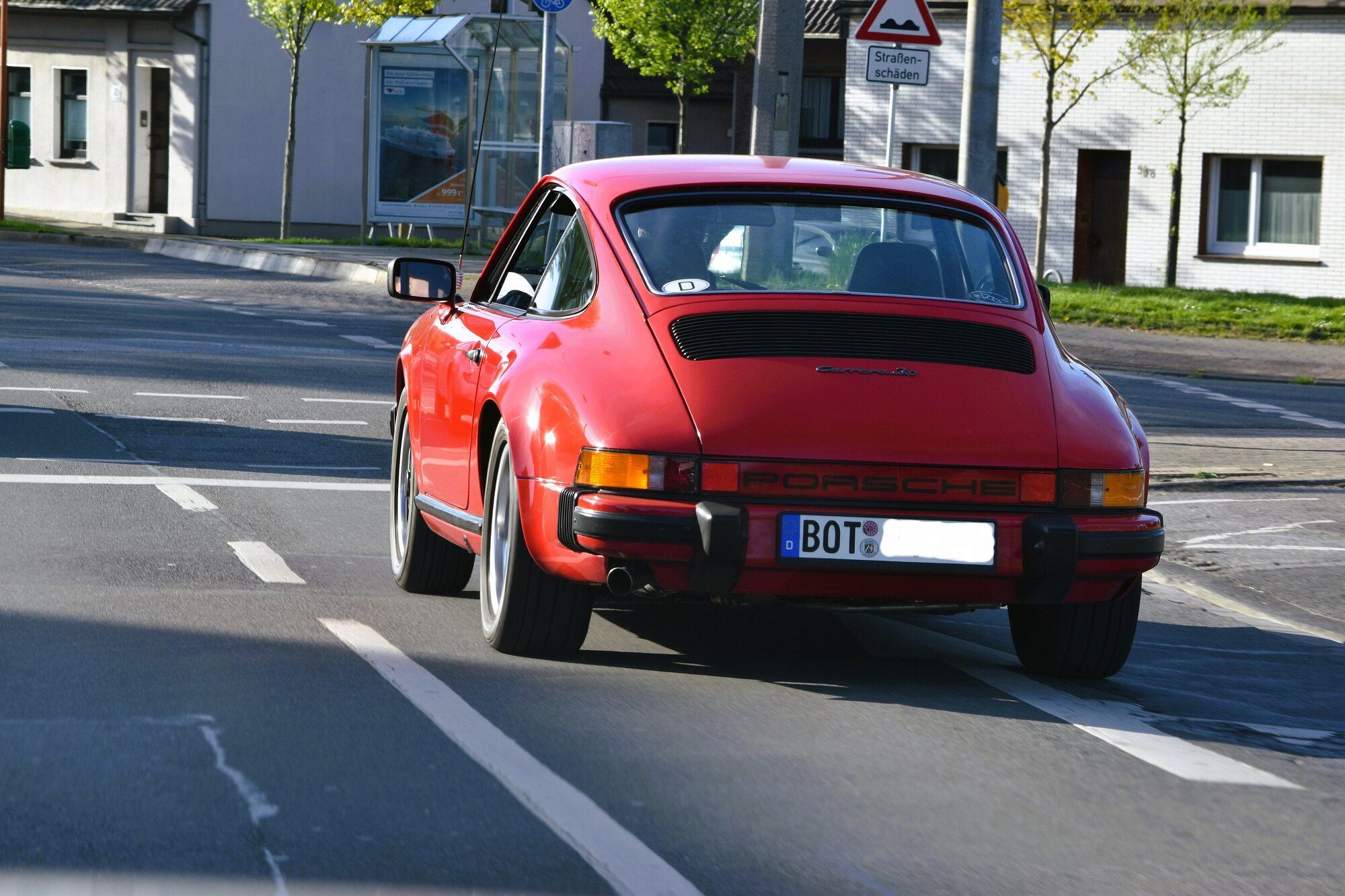
Porsche does not say which G-model feature it means. It names no panel, lamp or year. The closest match in Porsche's own G-model history is the rear, where a red light strip with the Porsche logo ran between the tail lamps, as in the photo above. That is our reading, not a statement from Porsche.
The G-model outlived the cars designed to replace it. Porsche presents the Mission S differently: as a platform "positioned above the 911", not a successor to it. Seeabove the 911 for what that means in Porsche's range.
Quick answers
Why is it called the G-model?
G was Porsche's internal letter for the 1974 model year, the first of the new generation. Porsche says the name strictly applies only to that year. Later years were H, J, K and so on, but "G-Series" stuck for the whole 1973 to 1989 generation.
How many G-model 911s were built?
Porsche gives 198,496 in two of its histories and 196,397 in a third.
Why does the G-model have big bumpers?
Porsche says US safety rules required new cars to withstand a 5 mph (8 km/h) impact, forwards or backwards, without damage. The G-model's bellows bumpers could compress by up to 50 mm without harming important parts. The US bumper standard of the time, No. 215, was published in 1971 with a 5 mph front test.
What does the Mission S take from the G-model?
Porsche says its shut lines, which merge into the light graphics, pay homage to the G model. It has not said which G-model detail it means.
Notes on the numbers
- Production: 198,496 in Porsche's 2018 seven-generations article and its 50 years of the G-Series history. 196,397 in its 60 Years of the 911 press kit.
- Carrera 2.7 output: the same Porsche history gives 210 PS as both 148 kW and 154 kW. 210 PS is 154 kW.
- Turbo performance: 0 to 100 km/h in 5.2 seconds and "more than 260 km/h" (2018). 5.4 seconds and "up to 260 km/h" (the G-Series history).
- Turbo dates: Porsche dates the Turbo to 1974, when it was shown at the Paris Motor Show. It reached the road as a coupé in March 1975.
- Bumper test speeds: Porsche's histories give one figure, 5 mph (8 km/h), front and rear. Standard No. 215 as published in 1971 gives 5 mph at the front and 2.5 mph (barrier) or 4 mph (pendulum) at the rear. We have not read the later amendments to the standard.
Keep reading
- Porsche's mid-engine supercars550 Spyder, 904, GT1, Carrera GT, 918 Spyder, Mission S.
- Porsche 356The first Porsche, and the interior idea the Mission S borrows.
- Porsche 550 SpyderThe first Porsche super sports car, and the 1953 Queens pier photo.
- Porsche 904 Carrera GTSA mid-engined road and race car with a plastic body.
- Porsche 917The Le Mans winner and its cooling-air fan.
- Porsche 928The front-engined V8 Porsche and its phone-dial wheels.
- Porsche 959The 1980s technology flagship and its roofline.
- Porsche 911 GT1The Le Mans car with a road version and a mid-mounted flat-six.
- Porsche Carrera GTThe V10 with a manual gearbox, 1,270 built.
- Porsche 918 SpyderThe plug-in hybrid hypercar, 918 built.
- Porsche flat-eight enginesEvery Porsche that has used one, from the 804 to the 914/8.
- Porsche Mission S overviewWhat the car is, why Queens, and the quick answers.
- Every Porsche Mission conceptMission E, E Cross Turismo, R, X and S, and what each one led to.
Sources
- Porsche Mission S: the essence of the sports car reinterpreted, Porsche Newsroom, 2026-10-15. The shut lines that merge into the light graphics, the wraparound main line, "positioned above the 911".
- What is the Porsche Mission S? Everything you need to know, Porsche, 2026-10-19. The shut lines as a homage to "classic 911 G-Series models".
- 50 years of the Porsche 911 (G-Series): the evergreen Porsche sports car, Porsche Newsroom (60 Years Porsche 911 press kit), undated. Bumpers, Lapine, the rear light strip, length, models and outputs, the oil crisis, transaxle cars, naming, Speedster, production 198,496.
- 2nd Generation 911 (G-Series), 1973 to 1989, Porsche Newsroom (60 Years Porsche 911 press kit), undated. August 1973 start, 1989 end, production 196,397.
- The G model: The 911 gets off to a flying start with technical innovations, Porsche Newsroom, 2018-11-22. Bumper compression, Turbo performance, production 198,496.
- Motor Vehicle Safety Standard No. 215, Exterior Protection, Passenger Cars (36 FR 7218; PDF of the full day's issue, 25 MB), National Highway Traffic Safety Administration, in the Federal Register, 1971-04-16. Pages 7218 to 7219 of the issue: effective dates, the 5 mph, 2.5 mph and 4 mph test speeds, the protective criteria, and the note that further changes were expected.
- 49 CFR Part 581, Bumper Standard, Electronic Code of Federal Regulations (eCFR), current text, read 2026-11-10. Section 581.5: the 2.5 mph and 1.5 mph test speeds in force today.
Spotted an error? Tell us and it goes on the corrections log.