Porsche 917
The 917 gave Porsche its first overall win at Le Mans. The Mission S refers to one part of it: the fan that cooled its engine. This page covers the car, the fan and how far Porsche's claim goes.
By Mario Bailey. Published , updated .

The short answer
- Porsche built 25 917s to homologate it as a Group 4 sports car. FIA inspectors saw them lined up at Zuffenhausen on 21 April 1969.
- Its air-cooled twelve-cylinder engine, designed by Hans Mezger, made 580 PS from 4.5 liters at first and was cooled by one central fan.
- The 917 gave Porsche its first two overall Le Mans wins, in 1970 (Herrmann and Attwood) and 1971 (van Lennep and Marko).
- The turbocharged 917/30 won six of eight Can-Am races in 1973 and the title for Mark Donohue.
- Porsche says the Mission S cooling solution is "reminiscent of the Porsche 917's radiator fan". It has not said what that fan cools or whether it reaches production.
Checked against Porsche's own releases on .
Twenty-five cars in under a year
Hans Mezger, then head of motorsport and responsible for the whole project, recalled in 2019 that homologation in the five-liter category technically called for 50 cars: "But neither Ferrari nor ourselves would have managed that. And so the requirement was brought down to just 25 units." His department began design work in June 1968, before it had the official go-ahead. The first engine ran on the test bench in early December.
Chassis 917-001 was finished on 10 March 1969, two days before the car's debut at the Geneva Motor Show on 12 March. Mechanic Gerhard Küchle says he and two or three colleagues built all 25 homologation engines by hand. Process planner Hermann Burst lined all 25 cars up with a rope on the management parking lot of Plant 1 for the FIA inspection on 21 April 1969. The inspector picked number 12, which started and drove to the factory gates and back. Burst later admitted that by coincidence it was one of the cars that had all its suspension springs. Some were standing on water pipes.
The engine and its fan
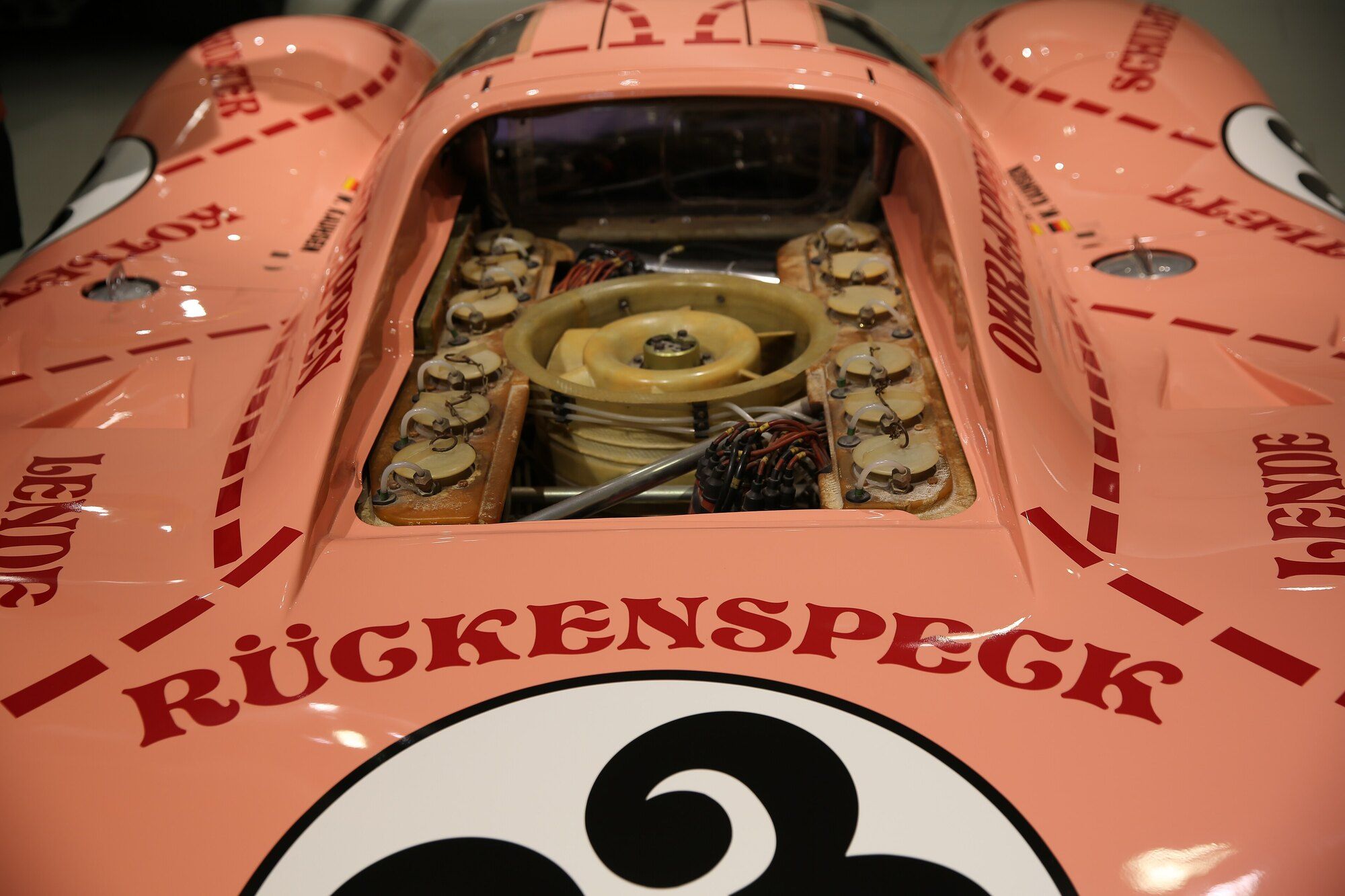
Mezger says the twelve-cylinder had to be designed from scratch, with few parts carried over from other engines. In 4.5-liter form it made what Porsche calls "a previously inconceivable output power of 580 PS". It was air-cooled, and its cylinders lay in two flat banks either side of the crankshaft. Porsche's own texts call it a flat-12, a horizontally opposed engine and a V12 with a 180-degree bank angle. All three describe the same layout.
Cooling twelve cylinders by air was the job of one central fan, which in the photo below sits flat on top of the engine. Porsche's 2019 story about Mezger's cylinder studs shows how much that fan shaped the engine. The studs sat beside the cylinders "in the path of the wind", so the fan kept them too cool to expand with the hot magnesium and aluminum around them. Mezger's fix was to coat them: "We simply coated them with an insulating layer, which made sure they stayed hot."

Le Mans, then Can-Am
The 917 was hard to drive at first. "It was driving us rather than the other way round," Hans Herrmann said, until the aerodynamics were improved. On 14 June 1970 he and Richard Attwood won Le Mans in the red and white 917 KH of Porsche Salzburg, start number 23, after 343 laps and 4,607.811 km in a race Herrmann describes as dominated by rain. It was Porsche's first overall win there. In 1969 Porsche had missed victory by 75 meters. A 917 KH won again in 1971 with Gijs van Lennep and Helmut Marko, and the 917 helped Porsche to the manufacturers' title in the World Sportscar Championship in both years.
In 1972 the motorsport authorities banned the five-liter twelve-cylinder from the World Championship, so Porsche took the car to the North American Can-Am series and turbocharged it. The 917/10 won the 1972 title. The 917/30 of 1973 had a turbocharged 5.4-liter engine and a longer wheelbase, up from 2,310 to 2,500 mm, and Mark Donohue won six of the eight races and the championship. The rules changed again and the 917 was excluded. On 9 August 1975 Donohue took a 917/30 round the Talladega Superspeedway at an average of 355.78 km/h, a world record that Porsche says stood for eleven years.
What the Mission S takes from the 917
Porsche mentions the 917 in three places, each in slightly different words. The Mission S press release lists "the cooling solution reminiscent of the Porsche 917's radiator fan" among technical details that "combine function and design". A Porsche story calls it "the cooling fan in the rear section of the Porsche Mission S". Porsche's model page goes furthest: "The prominently displayed fan wheel in lightweight construction supports cooling", while also paying homage to the 917.
Porsche has confirmed this much: the show car has a visible fan wheel in its rear section, the fan wheel is of lightweight construction, and it supports cooling. Porsche has not said what the fan cools (engine, radiators, brakes or something else), whether it is driven electrically or mechanically, or whether a production car would keep it. Porsche has not named the engine either (see the engine page), so it is not known whether this fan does the same job as the 917's.
Porsche has used the 917 fan as a design reference before. In 2014 it built a design study that only a few managers knew about, the 917 Living Legends, with a planned 750 PS twin-turbo V8 and "a folding air scoop above the engine featuring a fan wheel". Porsche showed it to the original 917 team in 2019 and said some of its details reached production cars. For every other reference on the Mission S, see the design references, and for the cars that came before it, Porsche's mid-engined super sports cars.
Quick answers
Why does the Porsche 917 have a big fan on top of the engine?
Its twelve-cylinder engine was air-cooled. Porsche describes a central cooling-air fan that blew across the cylinders, which lay in two flat banks.
How many Porsche 917s were built?
Porsche built 25 for homologation, shown to the FIA inspectors on 21 April 1969. A 2023 Porsche story says some 65 were built in total.
When did the 917 win Le Mans?
In 1970, with Hans Herrmann and Richard Attwood in the 917 KH entered by Porsche Salzburg, and again in 1971 with Gijs van Lennep and Helmut Marko. They were Porsche's first two overall wins at Le Mans.
Does the Mission S have a 917-style fan?
Porsche says it has a "prominently displayed fan wheel in lightweight construction" that "supports cooling" and pays homage to the 917. It has not said what the fan cools or how it is driven, and the Mission S is a show car, not a production model.
Notes on the numbers
- 917 output: 580 PS (2019) or 580 hp (2020) from 4.5 liters in Porsche's newsroom articles. A 2023 Porsche story gives 588 PS. The 917 LH is quoted at 4.9 liters and 600 hp, and Porsche says the engine was later bored out to five liters.
- Engine name: Porsche's museum entry for the 917/30 lists a "12-Cyl. 180° V". Other Porsche pages say flat-12 or horizontally opposed. Same engine family, different labels.
- 917/30 output: 882 kW (1,200 HP) in the museum entry and 882 kW (1,200 PS) on Porsche's heritage page. 1,100 hp in Porsche's 2018 article. 1,014 PS in a 2023 Porsche story. Porsche's 2018 article gives 1,230 hp for the 1975 Talladega car with intercoolers.
- Numbers built: 25 for homologation is consistent across Porsche sources. "Some 65" in total comes from one 2023 Porsche story.
Keep reading
- Porsche's mid-engine supercars550 Spyder, 904, GT1, Carrera GT, 918 Spyder, Mission S.
- Porsche 356The first Porsche, and the interior idea the Mission S borrows.
- Porsche 550 SpyderThe first Porsche super sports car, and the 1953 Queens pier photo.
- Porsche 904 Carrera GTSA mid-engined road and race car with a plastic body.
- Porsche 911 G-modelThe impact-bumper 911 and the shut lines the Mission S quotes.
- Porsche 928The front-engined V8 Porsche and its phone-dial wheels.
- Porsche 959The 1980s technology flagship and its roofline.
- Porsche 911 GT1The Le Mans car with a road version and a mid-mounted flat-six.
- Porsche Carrera GTThe V10 with a manual gearbox, 1,270 built.
- Porsche 918 SpyderThe plug-in hybrid hypercar, 918 built.
- Porsche flat-eight enginesEvery Porsche that has used one, from the 804 to the 914/8.
- Porsche Mission S overviewWhat the car is, why Queens, and the quick answers.
- Every Porsche Mission conceptMission E, E Cross Turismo, R, X and S, and what each one led to.
Sources
- Porsche Mission S: the essence of the sports car reinterpreted, Porsche Newsroom, 2026-10-15. The Mission S cooling solution "reminiscent of the Porsche 917's radiator fan".
- What is the Porsche Mission S? Everything you need to know, Porsche, 2026-10-19. The cooling fan in the rear section of the Mission S.
- Mission S (model page), Porsche, undated. The fan wheel in lightweight construction that supports cooling.
- Makers' day, Porsche Newsroom, 2019-05-02. Mezger on the 25-car rule, design start, 580 PS, Küchle on the engines, the 21 April 1969 inspection, the 917 Living Legends study.
- 1969: Year of Change, Porsche Christophorus (No. 391), 2019. 917-001 completion, Geneva debut on 12 March 1969, Group 4 homologation.
- Icon (the 917 cylinder studs), Porsche Christophorus (No. 390), 2019. The central cooling-air fan and the coated studs; the red and white winning car.
- Air-cooled legends, Porsche Newsroom, 2018-03-08. Air cooling; 917 LH at 4.9 liters and 600 hp.
- The creative spirit, Porsche Newsroom, 2020-01-07. Mezger as designer of the 917 and its V12 with a 180-degree bank angle.
- Porsche achieved the first overall victory at Le Mans 50 years ago, Porsche Newsroom, 2020-06-03. The 1970 and 1971 Le Mans wins, distance, laps, the 1969 margin, Herrmann quotes.
- What is the Porsche 917?, Porsche, 2023-02-03. Flat-12, 588 PS, five liters, about 65 built, 1,014 PS for the 917/30.
- Record breaking Porsche 919 Evo meets its legendary predecessor 917/30, Porsche Newsroom, 2018-09-29. The engine ban, the 1970 and 1971 manufacturers' titles, 917/10 and 917/30 in Can-Am, wheelbase, 1,100 hp, Talladega record.
- Porsche 917/30 Spyder (Porsche Museum press kit), Porsche Newsroom, undated. 917/30 engine, 5,374 cc, 882 kW (1,200 HP), exclusion from Can-Am.
- Heritage, Porsche AG investor relations, undated. 25 cars by end of April 1969, 1970 manufacturers' championship, 882 kW (1,200 PS).
Spotted an error? Tell us and it goes on the corrections log.