Porsche 911 GT1
A Le Mans car wearing a 911's face, with its engine moved to the middle and a few road cars built so it could race. Porsche credits it with two of the Mission S's defining features, more than any other car it named except the 911 itself.
By Mario Bailey. Published , updated .

The short answer
- The 911 GT1 made its racing debut in 1996 and finished second and third overall at Le Mans that year.
- A works 911 GT1-98 won the 1998 24 Hours of Le Mans outright, with the second works car in second place.
- Despite the name, its flat-six was mid-mounted, "as opposed to the regular rear-engined 911", in Porsche's words.
- About 20 road-going Strassenversion cars were built so the racer could compete; Porsche gives 544 PS from a 3.2-liter twin-turbo flat-six.
- Porsche says the Mission S takes its flat front and its "car-in-car" rear from the GT1.
Checked against Porsche's own pages and the Le Mans organizer's history on .
Why Porsche built it
By the mid-1990s, GT cars had become serious contenders for outright victory at Le Mans; the Le Mans organizer points to the McLaren F1 GTR's win in 1995. Porsche's answer was a new competition car developed, in the Porsche Museum's words, "for works and customer use in GT motorsport". It made its racing debut in 1996.
The Le Mans organizer's history says the GT1 used the engine of the 962 C prototype, the car that won Le Mans in 1986 and 1987. Porsche's museum entry adds that it was water-cooled and mounted in the middle of the car for a balanced load on the two axles.
Why a "911" had its engine in the middle
Porsche says the engine was "mounted in a mid-engine position (as opposed to the regular rear-engined 911)". Its styling, Porsche says, "derived much from the type 993-era 911 of the time", while "its sweeping rear end, meanwhile, resembled the 962 race car". Later cars took front-end parts from the type 996 911; Porsche's 2016 history describes the road cars as having "a front that is synonymous with the 996 model range".
So the 911 badge described the face and the family, not the layout. Ahead of the doors the car looked like the 911 buyers knew; behind them it was a prototype racer. Porsche now cites both ends of the GT1 as references for the Mission S. For what moving the engine changes, seewhy mid-engine.
Le Mans, 1996 to 1998
1996. On its first appearance the GT1 finished second and third overall, first and second in the LMGT1 class, behind the Joest Racing TWR Porsche WSC-95 prototype.
1997. Eight 911 GT1s started, two of them works cars. The two works cars fought for the lead, and both dropped out, one after an incident in the Porsche Curves and the other after a fire. The best GT1 finish went to a privately entered car in fifth.
1998. Porsche reworked the car as the 911 GT1-98, with what its museum calls "the first carbon fibre chassis to be used by Porsche". The race became a duel with Toyota's GT-One, which led until gearbox failure about 90 minutes from the end. The number 26 Porsche of Laurent Aiello, Allan McNish and Stéphane Ortelli won outright, with the number 25 car of Jörg Müller, Uwe Alzen and Bob Wollek second. It was Porsche's 50th anniversary year, and the Le Mans organizer notes that Ferry Porsche had died on 27 March, before he could see it.
The Strassenversion road cars
Endurance racing cars needed a homologated road version in order to compete, Porsche explains, so it built one. Its 2016 history says a small series of at least 20 road cars was required, that Porsche met the quota, and that even the road cars were built by the racing department in Weissach.
Porsche's 2025 story on the car gives the most detailed count: two prototype road cars in 1996 for homologation (one passage of the same story says one), approximately 20 cars in 1997, and a single lighter car in 1998, again for homologation. Porsche's hypercar story puts the total at 21. The road cars used a 3.2-liter twin-turbo flat-six with 544 PS, against nearly 600 PS in the race car, and reached 100 km/h in 3.9 seconds. The 2016 history describes the body as carbon fiber and Kevlar.
On price, Porsche's 2016 history gives DM 1.5 million, and Porsche's hypercar story says a 1998 road car "originally sold for around $900,000 when new". The two figures are in different currencies and Porsche does not reconcile them.

What the Mission S takes from the GT1
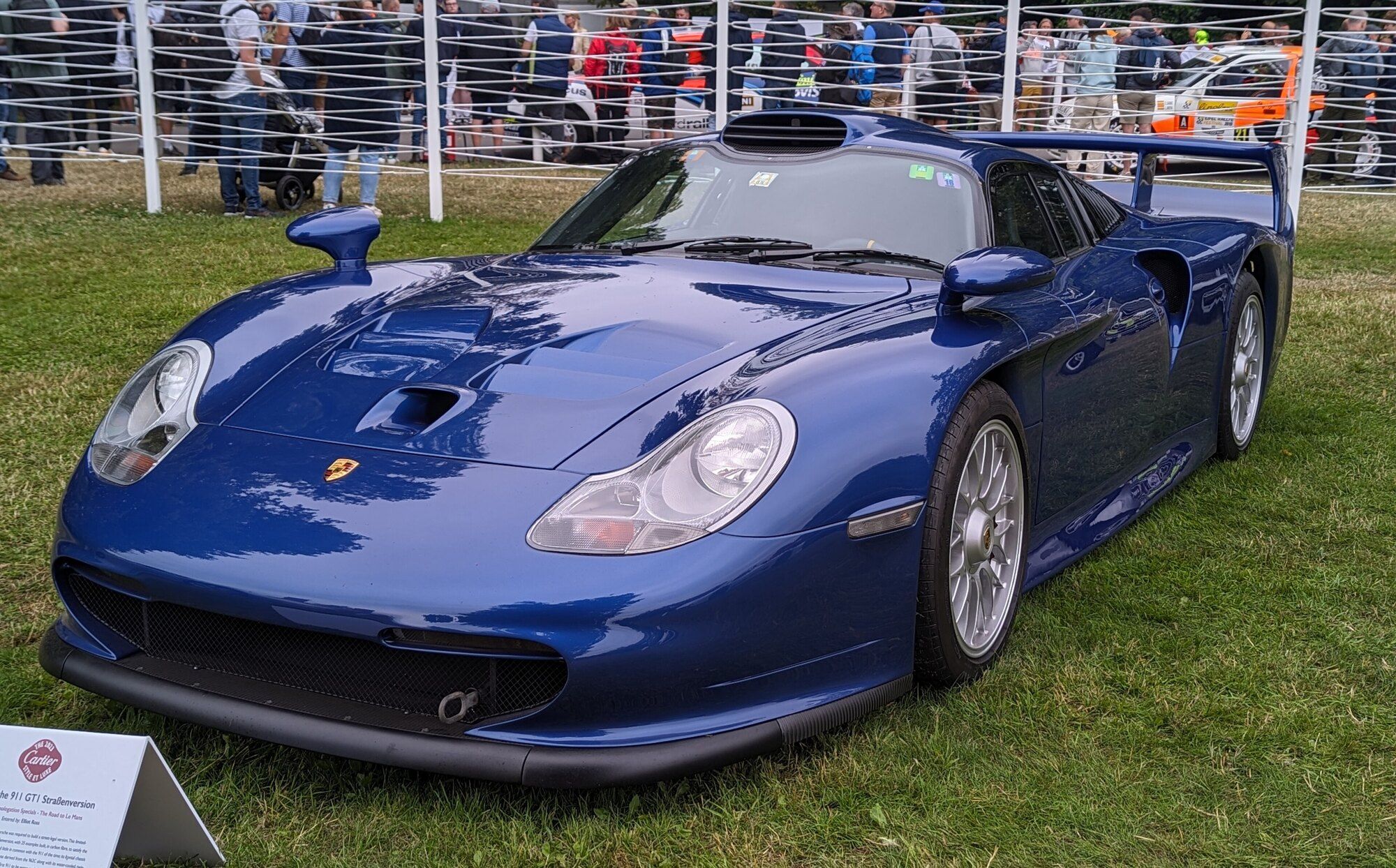
Porsche's release names the GT1 twice. "The flat front takes its cue from the GT1," it says, and later: "Another highlight is the car-in-car concept at the rear, derived from the GT1." No other historic car in the release, apart from the 911 itself, is credited with more than one feature. The design page shows both on the official photos.
The flat front is easy to see on the photos on this page: the GT1's nose is low and flat. On the Mission S it sits between the raised "torpedo" fenders that Porsche credits to the 911. "Car-in-car" is harder, because Porsche does not define it. Our reading, and it is only that: the GT1 was a racing car's rear end set inside a road car's outline, and the Mission S rear presents a technical inner section inside the outer body. That fits the release's description of the lower surfaces, which "make technical functions visible and emphasise the lightweight construction philosophy".
The two cars also share a layout. The GT1 carried the 911 name and a mid-mounted engine. The Mission S does not borrow the name: Porsche calls it a mid-engined super sports car platform "positioned above the 911". Where the GT1 was a racing car that needed a few road cars, Porsche presents the Mission S as a road car meant to stay on sale; seeabove the 911 and the full mid-engined line.
Quick answers
Is the Porsche 911 GT1 really a 911?
In name and in its face, yes; in layout, no. Porsche says its flat-six was mounted in a mid-engine position, as opposed to the regular rear-engined 911, and its rear end resembled the 962 racing car.
How many 911 GT1 Strassenversion road cars were built?
Approximately 20 for customers in 1997, plus one or two homologation cars in 1996 and one lighter car in 1998, according to Porsche's 2025 story on the car. Porsche's hypercar story gives 21 road-legal cars, and its 2016 history says at least 20 were required.
Did the Porsche 911 GT1 win Le Mans?
Yes. In 1998 a works 911 GT1-98 driven by Laurent Aiello, Allan McNish and Stéphane Ortelli won the 24 Hours of Le Mans outright, with the sister car second.
What does the Mission S take from the 911 GT1?
Porsche says the Mission S flat front takes its cue from the GT1, and its car-in-car concept at the rear is derived from the GT1.
Notes on the numbers
- Road car output: Porsche's 2025 GT1 story gives 544 PS (536 hp); its 2016 history gives 544 bhp (400 kW). The figure is the same; the unit labels differ.
- Top speed: 309 km/h for the 1996 and 1997 road cars and 308 km/h for the 1998 car in the 2025 GT1 story; 310 km/h in the 2016 history and in Porsche's hypercar story.
- 0 to 100 km/h: 3.9 seconds in the 2025 GT1 story; 3.6 seconds in Porsche's hypercar story.
- Production: "approximately 20" in 1997 plus one or two homologation cars in 1996 and one in 1998 (2025 GT1 story), 21 (hypercar story), "at least 20" required (2016 history).
- Win count: we do not give a running total of Porsche's Le Mans wins for 1998, because the sources number it differently: Porsche's 2025 GT1 story calls it the 16th, and the Le Mans organizer's history says Porsche was "winning for the 17th time".
Keep reading
- Porsche's mid-engine supercars550 Spyder, 904, GT1, Carrera GT, 918 Spyder, Mission S.
- Porsche 356The first Porsche, and the interior idea the Mission S borrows.
- Porsche 550 SpyderThe first Porsche super sports car, and the 1953 Queens pier photo.
- Porsche 904 Carrera GTSA mid-engined road and race car with a plastic body.
- Porsche 917The Le Mans winner and its cooling-air fan.
- Porsche 911 G-modelThe impact-bumper 911 and the shut lines the Mission S quotes.
- Porsche 928The front-engined V8 Porsche and its phone-dial wheels.
- Porsche 959The 1980s technology flagship and its roofline.
- Porsche Carrera GTThe V10 with a manual gearbox, 1,270 built.
- Porsche 918 SpyderThe plug-in hybrid hypercar, 918 built.
- Porsche flat-eight enginesEvery Porsche that has used one, from the 804 to the 914/8.
- Porsche Mission S overviewWhat the car is, why Queens, and the quick answers.
- Every Porsche Mission conceptMission E, E Cross Turismo, R, X and S, and what each one led to.
Sources
- What is the Porsche 911 GT1 Strassenversion?, Porsche, 2025-09-05. Mid-engine position, 993, 996 and 962 styling, road car production by year, 544 PS, 0 to 100 km/h in 3.9 seconds, top speeds, Le Mans 1996 to 1998.
- Porsche 911 GT1 '98 (Porsche Museum press kit), Porsche Newsroom, undated. 1996 racing debut, water-cooled mid-engine, 1998 carbon-fiber chassis.
- The super sportscars from Porsche, Porsche Newsroom, 2016-01-02. At least 20 road cars required, built in Weissach, 996 front, carbon-fiber Kevlar body, DM 1.5 million, 310 km/h.
- Six of the greatest Porsche hypercars, from the Carrera GT to the 918, Porsche, 2025-07-21. 21 road-legal cars, 310 km/h, 0 to 100 km/h in 3.6 seconds, and the price of around $900,000 when new.
- Porsche 911 GT1 (1), 1996-1997, a new generation, 24 Hours of Le Mans (ACO), 2017-04-03. Why the GT1 was built, 962 C engine, 1996 result, 1997 race.
- Porsche 911 GT1 (2), 1998, an emotional victory, 24 Hours of Le Mans (ACO), 2017-04-04. 1998 race, crews, Toyota retirement, 50th anniversary, Ferry Porsche's death on 27 March.
- Porsche Mission S: the essence of the sports car reinterpreted, Porsche Newsroom, 2026-10-15. The GT1 references (flat front, car-in-car rear) and the platform positioned above the 911.
Spotted an error? Tell us and it goes on the corrections log.